Why Our Label Still Tracks Through Hardware in a Plugin World
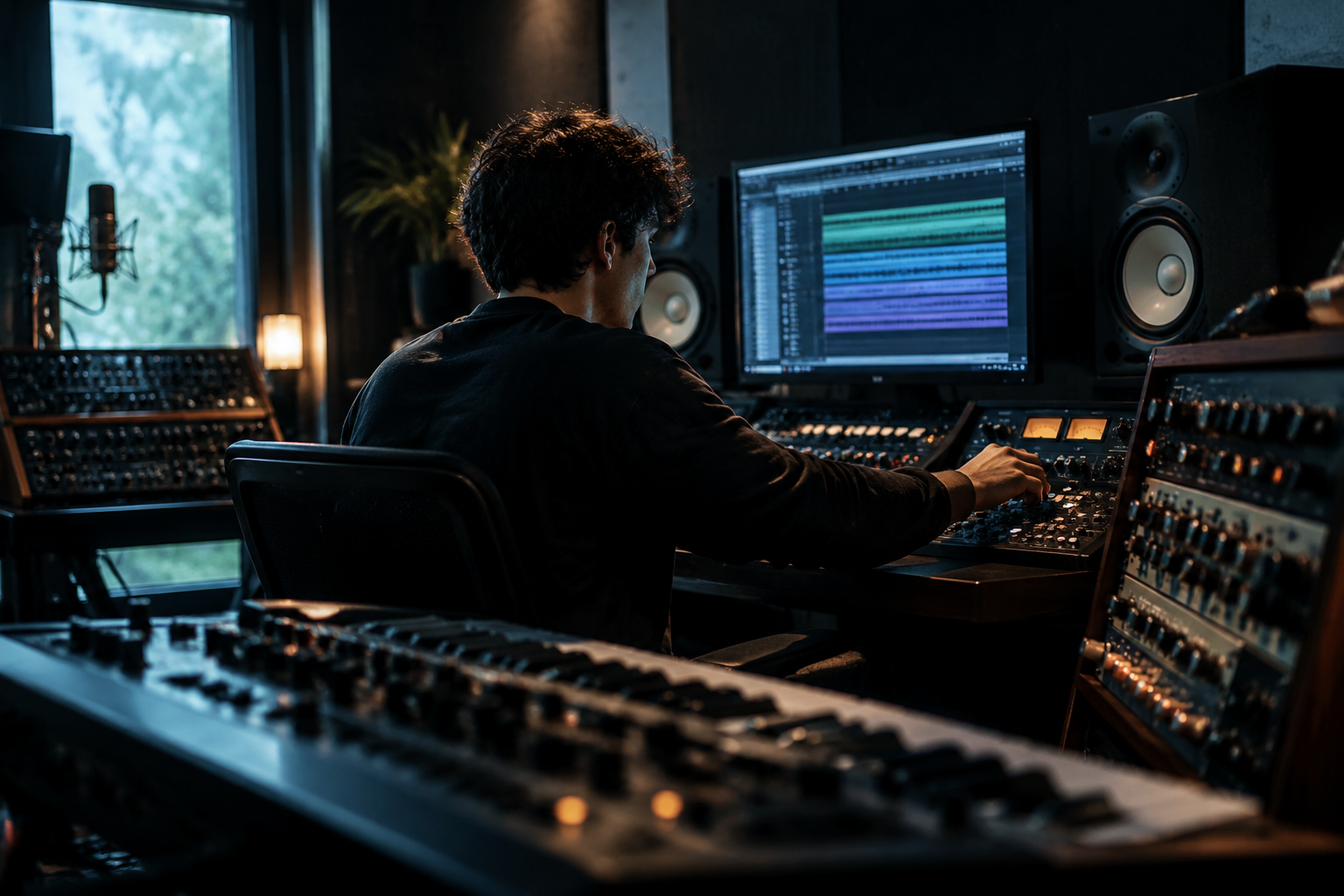
We build our records the slow way. Not because we’re precious about it, and not because we think a hardware synth sounds magically better than a plugin, most of the time it doesn’t, and anyone who tells you otherwise hasn’t A/B’d a modern soft synth against a Juno lately. We track through hardware because of what it does to the people in the room. The decisions get firmer, the ears get sharper, and the session stops being a mouse marathon. The argument holds, and it deserves a closer look.
The Screen Is Where Inspiration Goes to Die
Here’s the thing nobody warns you about when you go fully in-the-box: composing, arranging, mixing and mastering all collapse into the same tool, often the same screen, using the same gestures. You finish a mix and realize you’ve been staring at the same rectangle for nine hours. For a lot of us, making music has become a completely computer-dependent activity, and that dependency quietly eats at the pleasure of doing it.
Hardware is the exit door. Turning a knob, playing a sequence or sculpting a sound without a software interface changes the experience of composing. It’s a way back into a direct relationship with the instrument. When the studio is a wall of screens, you don’t hear the music anymore, you look at it. You start reading a frequency curve instead of listening to a sound. You click a volume envelope instead of feeling it with your fingers. That mental break isn’t a luxury; over a long project, it’s the thing that keeps you showing up.
Making a Take Means Committing to It
This is the part that actually changes our records. In a DAW, the temptation to fiddle is always there, you can recolor a synth at 95% finished and nobody stops you. That flexibility sounds like freedom until you realize you’ve spent three days micro-adjusting things that add nothing to the emotion of the track. It’s a trap disguised as a feature.
With hardware, that flexibility disappears. When you print a take from a hardware synth, the sound is frozen. You made a choice, and now you live with it. That single constraint moves projects forward faster than any workflow hack we’ve tried.
- Tracks stop being endless drafts and become layers, each with its own identity, definitive and assumed.
- You learn to live with your decisions, which builds real confidence in your own aesthetic instead of constant second-guessing.
- You build the piece stone by stone rather than circling the same eight bars forever.
Yes, you can MIDI-record everything and keep full recall. But the whole point is that we usually don’t. We print audio, archive the patch, and move on. The song gets done because the song has to get done.
The Imperfections Are the Point
Vintage hardware has historical flaws. Oscillator instability, thermal drift, occasionally unpredictable behavior depending on your electrical voltage, all of it technically a problem, all of it part of an instrument’s character. Those imperfections introduce variations and surprises that break up the too-smooth perfection of the software world.
Software is generally built around absolute precision and, above all, perfect reproducibility. That’s excellent for a mix bus. It’s less excellent when you’re trying to catch something alive. Even when plugin developers deliberately design in variation and mess, the relationship is different: hardware doesn’t have to be told to wobble. Working with real machines means accepting a different relationship to time and to certainty, you don’t always save everything exactly as it was, and that’s fine. The happy accident is part of the method, not an obstacle to it.
Muscle Memory Beats a Parameter List
There’s a tactile dimension here that’s hard to quantify and impossible to fake. A hardware synth, analog or digital, isn’t just a sound generator in a processor, it’s an object with a specific presence, ergonomics and response. Sound isn’t only what you hear; it’s what you physically manipulate. That shapes the way you play and program.
Every machine has its own logic, and its ergonomic strengths and weaknesses push you in directions you wouldn’t have explored with a mouse. You develop muscle memory like a guitarist knows their neck, interaction becomes instinctive, and the tool turns into a genuine playing partner rather than a library of sounds. One function per button buys a spontaneity that software, despite every controller on the market, still can’t quite match. And simple ergonomics encourage serendipity: you turn a knob out of curiosity and land on a texture you’d never have dialed in deliberately. Those moments are far rarer in the virtual world, where we default to presets and beaten paths.
Resistance to Infinite Choice
When you own ten thousand sounds, there’s no guarantee you finish a single piece. If anything, the profusion causes the paralysis. Choosing one specific machine means accepting its universe, its filters, its oscillators, its limits. You learn that instrument deeply instead of skimming presets forever.
That deliberate simplicity is a form of resistance to overabundance, and it focuses you on what actually matters: melody, rhythm and emotion. Obviously the irony isn’t lost on us, a certain brand with a famous vowel in its name keeps shipping budget hardware that resets the whole scarcity argument. The point stands anyway: fewer options, deeper mastery. That’s the trade we keep making.
Where Plugin-Native Products Earn Their Place
We’re not religious about this, and we’d be lying if we said our sessions were hardware-only. Our basslines come from a plugin. Our time correction is a plugin. Our mix bus is a plugin, and it’s better than anything we could have wired up outboard for the money.
The hardware-only philosophy has limits, and modern plugin releases are proof. Take something like Bitwig Studio 6, Clip Aliases, the feature that links multiple clips so editing a master clip updates every alias, is a genuine time-saver on complex projects, and the global tonality system with 23 available ranges, automatable over time, makes it easy to generate harmonically coherent patterns and experiment with rhythmic and melodic variations. Coming from Studio Pro and Ableton Live, the workflow speed is real. And yet there’s a gap: no proper chord track with dedicated tools, with MIDI plugins and modulators doing a lot of the work but never integrated cleanly. Even the best software is still catching up to how a musician’s brain actually wants to work.
Same story on the performance side. The Line 6 Helix Stadium XL Floor is the kind of box that replaces an entire rack. Two variable-impedance 1/4-inch instrument inputs with line-level switching, an XLR input with a real mic preamp, four send/return loops, dual XLR outs, S/PDIF on RCA, USB-C and USB-A, MIDI In and Out/Thru, a microSD slot, support for up to four expression pedals, and a Nexus port for the Expand D10 and future extensions. The chassis is solid and the power supply is internal, an IEC socket, the sort of brick-shithouse build you need for a stage box. As a solo artist, the ability to run a set without dragging a laptop and interface along is genuinely freeing, and the independent outputs managed through a virtual mixer let you dispatch signals very flexibly. It’s not flawless, the show mode’s workflow isn’t totally fluid and it’s easy to lose your place among cues, but the track-level Trim function is genuinely useful live, and the companion editor now works over Wi-Fi without a USB cable.
How We Actually Run It
Our room isn’t a museum. It’s a hybrid rig with rules:
- Hardware owns the parts where feel matters, main synth lines, bass, drum machines, anything a human plays with their hands. Printed to audio before the day ends.
- Plugins own precision work, editing, comping, surgical EQ, time alignment, and anything we’ll need to revisit across thirty sessions.
- One instrument per part. If we bought the machine, we use it. No auditioning five options for a two-bar pad.
- Print and archive. Audio plus a photo of the patch. If we need to redo a part, we redo it, we don’t recall it.
- Screen breaks are mandatory. Two hours of hands-on work for every hour of mouse work on production days.
That balance is the honest version of the “return to hardware.” We’re not rejecting progress or pretending software is weak, today’s algorithms are incredibly powerful, and a lot of our finished records rely on them. What we’re rejecting is the assumption that the most capable tool is automatically the right one. The hardware choice is about a different experience of playing music: a parenthesis, a suspended moment, not just another extension of time spent in front of a computer. We still track through machines because that’s where we make our best decisions, faster, firmer, and a lot more fun. The plugins are right there when we need them. They just don’t get to run the session anymore.