Vital Review: The Free Synth That Quietly Runs Half Our Patches
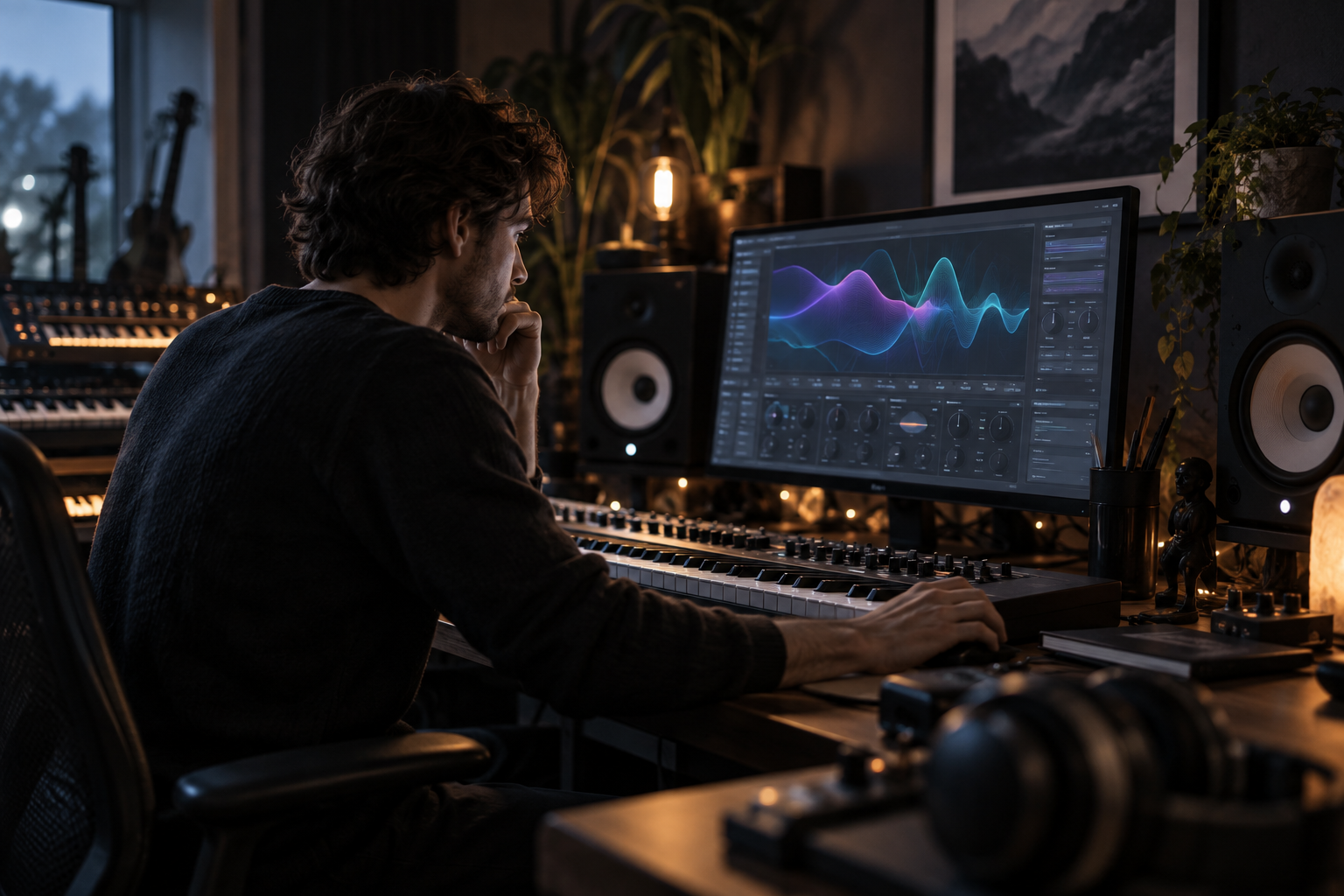
I keep a running joke with the people I work with: if you open a random project from the last three years on my drive, there’s a decent chance a Vital instance is sitting somewhere in it, labeled something unhelpful like “PAD_v7_FINAL_actual”. Not Serum. Not Massive. Not Diva. Vital. The free one. That wasn’t a deliberate decision, it happened organically, the way most of my workflow defaults do, and at some point I stopped pretending it was temporary.
Vital is a spectral warping wavetable synthesizer built by Matt Tytel, and it has earned a reputation that even people who don’t use it seem to accept: it’s widely regarded as the best free synthesizer out there, the one that gets compared directly to Xfer Serum and NI Massive on feature sets rather than on price. That framing is accurate, but it undersells why it actually ends up running so many of my patches. It’s not that it’s “good for free.” It’s that the workflow fits the way I design sounds, and I can hand the same instrument to a collaborator without them needing to own anything.
The free tier, honestly assessed
Let’s get the catch out of the way first, because it’s the thing people ask about before anything else. The free version of Vital ships with far fewer wavetables and presets than the paid tiers. That’s the real limitation, and it’s the same thing multiple reviewers flag, you just don’t get the same library depth. One producer who writes about it for synthwave work put it plainly: the free version doesn’t give you much to choose from out of the box, but since you can load your own wavetables and generate wavetables from samples, you never actually have to buy your way out of it.
That’s the crux. The free version is a complete instrument. Nothing about the synthesis engine is pared back, the caps land on custom wavetable slots (the free version tops out at a limited number) and on preset sharing features. Everything else, from the oscillators through the modulation system, is there. The paid tiers at lower and higher price points unlock a bigger preset library and more wavetable slots, but for actual production purposes the sonic reach is essentially unlimited. If you’re willing to build or source your own tables, the ceiling is wherever your patience ends.
Why the modulation system is the actual reason to use it
Wavetable synths are common. What keeps me coming back to Vital is how fast it lets me move from a static sound to something that breathes. The modulation routing is drag-and-drop visual, you grab a source, drop it on a destination, set the depth with a slider that shows you the range directly on the target control. No diving into a matrix to trace which LFO is touching what. After years of matrix-based synths where I’d spend ten minutes just remembering my own routing, that visual feedback matters more than any spec sheet suggests.
The filters are a big part of this too. They’re genuinely good and a little unusual, and once you start modulating filter parameters they stop being “a filter” and become a sound design tool in their own right. I’ll often use two filters in series with opposite modulation so they fight each other slightly, one opening while another closes, which gives a moving, almost vocal quality to pads and leads that I can’t easily get elsewhere without a lot of manual automation.
The spectral warping section is the other piece I lean on. It lets you distort the wavetable itself rather than the output, which means you can get aggressive, harmonics-heavy textures that still respond musically to pitch and modulation. For bass design especially, that’s where I go when a standard wavetable sweep isn’t cutting through.
Where it sits in the mix, genre-wise
One of the things that surprised me early on is how broad the fit is. Vital turns up constantly in drum and bass, dubstep, and synthwave, and plenty of people reach for it specifically for that 80s vintage character, which the filters handle well. But I’ve used it just as much for trap leads, ambient pads, and cinematic textures. It’s equally at home across pop and EDM production, which is a polite way of saying it doesn’t have a strong genre personality unless you force one on it. That’s a feature, not a weakness, it means you’re not fighting the instrument’s baked-in character.
The flip side: because it doesn’t have a signature sound the way a virtual-analog emulation does, it won’t hand you warmth for free. If I want thick analog-style pads or a Moog-ish low end, I’m reaching for something else. Vital gives me clean, modern, precise, and it’s on me to add the character afterward with saturation, tape, or a different synth layered underneath.
The ecosystem is the quiet advantage
Here’s the part that doesn’t show up in feature comparisons. Vital’s freeware status has spawned a sprawling secondary ecosystem, with plenty of free patch collections and a deep well of synthesis walkthroughs on YouTube. For someone learning, that’s a legitimate argument on its own. You’re not just getting a synth; you’re getting the biggest free library of instruction for any single instrument I can think of. When I’ve had interns or newer producers ask where to start, pointing them at Vital means pointing them at a community, not a dead end.
It also solves a practical problem I run into constantly: collaboration. When I send a project to someone, I don’t have to ask whether they own a $180 synth. They download Vital, they open the session, the patches load. That sounds small until you’ve spent an afternoon bouncing stems because a plugin license got in the way.
What it isn’t
I want to be straight about the tradeoffs, because the “best free synth” framing can read like there are none. Vital is not the synth for you if you want to sit down and audition a thousand presets. The factory library in the free version is thin, and you’ll need to put in time either hunting down free soundbanks or making your own tables. It’s also not the tool for authentic vintage grit, the character is neutral and modern by default. And if your workflow is deeply preset-driven and you never want to touch an oscillator’s internals, a synth with a fatter stock library will serve you faster.
Should it be in your folder
I’ve seen Vital described as the ultimate free synth plugin, offering premium features without the price tag, and after living inside it for years, I think that’s fair rather than hype. But the reason it ends up half my patches isn’t the price. It’s that the modulation workflow is fast, the filters are interesting enough to be worth modulating, and the spectral warping gives me textures I can’t quickly reproduce elsewhere. The zero-dollar entry point just removes every reason not to try it.
If you’ve been treating free plugins as a stepping stone to “real” tools, Vital is the one that quietly breaks that assumption. Download it, ignore the sparse preset list, and spend an afternoon building one wavetable from a sample you like. That’s usually the moment it stops being the free option and starts being the one you open first.