Best Plugins for Techno: The Rack Behind Our Last Three 12-Inches
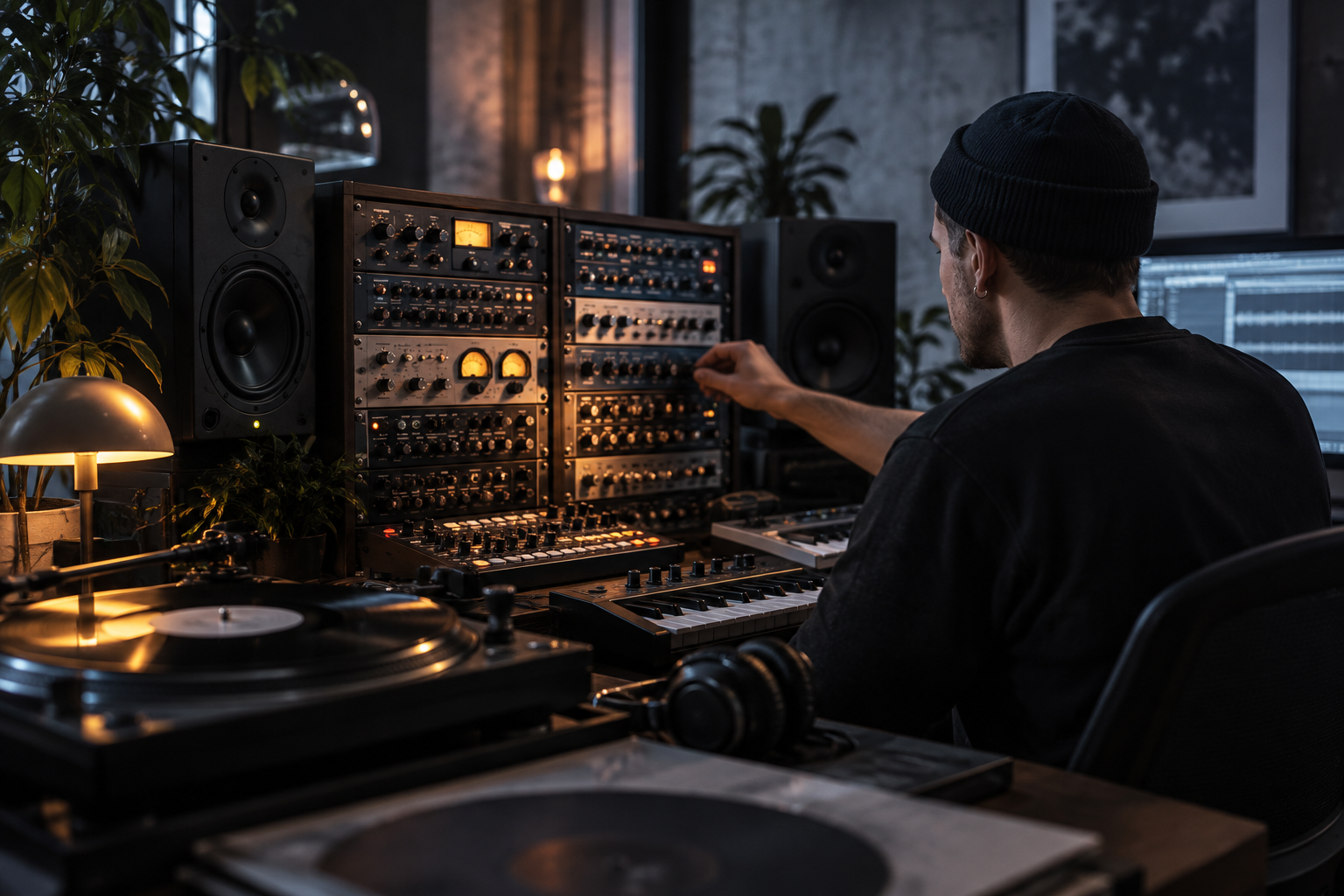
We finished three 12-inches this year, all cut from the same project folder, and the plugin list barely changed between them. That’s not laziness, it’s the result of a few years of A/B-ing tools against hardware, against each other, and against the one test that actually matters: does it still hold up when the mastering engineer sends back the reference and you play it on a big system at 4am?
This isn’t a “top 10 free plugins 2026” listicle. There are enough of those, and most of them are written by people who haven’t cut a record. What follows is the actual rack, the specific tools doing specific jobs on techno records that had to work on club rigs, in DJ sets, and on Bandcamp streams. Free and paid mixed together, because the price tag has almost nothing to do with whether a plugin actually belongs in your chain.
Why the free tier matters more than it used to
The free plugin landscape in 2026 is genuinely different from even three years ago. As Born To Produce puts it in their roundup, tools that would have cost hundreds a few years ago are now available for nothing, and they’re not “lite” versions or stripped-down demos. That matches what we’ve seen in the studio. From my own experience, the real test isn’t which freebies look good on paper but which tools a working producer would grab first if every paid license vanished overnight and the session still had to hold up to a commercial standard.
That framing is useful, because it forces you to evaluate free tools on the same terms as paid ones. I’ve stopped thinking in tiers. Below is how the rack actually breaks down.
Synthesis: the workhorses
Vital runs a huge amount of what we do, and it’s not a compromise. Three wavetable oscillators, a sampler engine, two filter blocks, plus a patch grid you wire by hand where every parameter shows its movement live. Born To Produce call it the single most important free plugin available and note it matches Xfer Serum in most practical scenarios, that’s not hype, that’s just what happens when you load both and try to make the same patch. We covered Vital in more depth elsewhere on here, so I won’t rehash the interface here.
Where Vital is a wavetable specialist, Surge XT is the generalist. Wavetable, subtractive, FM, and additive synthesis in one open-source package with over 2,000 factory presets. For techno specifically, the FM section is the part I reach for most, metallic stabs, inharmonic percussion, and those weird transient-rich textures that a pure wavetable synth makes you fight for. It updates regularly, which matters for a tool you’re going to build a workflow around.
For analog-flavored bass and pads, OB-Xf, the Surge team’s Oberheim OB-X emulation, does the warm, slightly unstable thing that pure digital synths struggle with. It’s not going to replace a real polysynth, but for the subs and mid-range pads sitting under a kick, it’s sitting in our sessions constantly.
Sound design tools that aren’t synths
MeldaProduction Rewind is technically an instrument, a granular and reverse-loop engine with 128 sound sources plus an FX chain, but in practice it’s a texture generator. Dreamy pads, reversed plucks, atmospheric beds. The tape-loop section gives you classic reverse-tape movement without printing and re-reversing audio, which used to be a 20-minute detour for a 2-second sound. It’s cheap rather than free, but it holds its own on the “weird” bus.
Pluralis, from United Plugins, is the other oddball. It’s a delay with signal-splitting modes, Mid/Side, Left/Right, Quiet/Loud, Low/High, so you can apply different delay settings to different parts of the signal. That’s a sound-design tool disguised as an echo. Subtle widening on one setting, genuinely unstable stereo chaos on another. Pairing it with a tape echo for free, as BPB notes, means you effectively get two delays for the price of one.
Dynamics: where the “hyper-real” sound lives
Xfer OTT is the single most divisive plugin in electronic music and also the most useful. Its multiband upward compression produces what Artists In DSP call the “hyper-real” electronic music sound, that squashed, forward, everything-at-once quality that defines a lot of modern techno. The trick is restraint. On a drum bus, OTT at 20-30% does more than most people’s entire processing chain. At 100% it’s a genre effect, not a mixing tool.
For the transparent stuff, TDR Kotelnikov is the wideband dynamics processor we keep on the mix bus permanently. It’s designed for clean compression on buses and the master, and you can push significant gain reduction without the artifacts cheaper compressors introduce. It’s free, which is genuinely surprising every time I open a session and remember that.
TDR Nova does the surgical work. Four-band dynamic EQ where every band responds to what hits it, engaging gain changes solely once specific frequencies pass a threshold. Major Mixing use it on vocals for de-essing and boxiness control, but the techno application is arguably better: taming the resonance that a resonant filter sweep leaves behind, without gutting the character that made the sweep interesting in the first place. It’s clean, lightweight, and competitive with paid dynamic EQs.
Color and saturation
Softube Saturation Knob is a one-knob aggressive grit box, modeled output distortion with frequency focus. On a drum bus it does exactly what the name says. There’s no menu, no modes, no preset browser. You turn it up until the drums sound better and then you stop.
For the 12-bit thing, Beatskillz AK9X is a vintage sampler-style processor focused on recreating classic 12-bit grit. Rather than loading sounds into a vintage sampler, you use this as an effect: drive the preamp, reduce audio bandwidth, flip stereo to mono, and get crunchy old-school textures instantly. On hi-hats and percussion it’s the difference between “clean modern loop” and “this came off a record.”
DelayU-42 from MKS Mixing is doing something more interesting than its name suggests. It’s a free vintage-inspired delay recreating classic 80s rack delays, grit, saturation, limiter behavior, dark echoes. The Input control drives the signal into the delay circuit, and the modeled opto-limiter reacts sooner as you push it. The Mix control affects how much of that limiter and saturation character is in the output, so the analog color stays active even at low mix settings. Set feedback to zero, delay time to zero, push the Input, and blend with Mix, you’ve turned a delay into a saturation box that does a very specific 80s-rack thing nothing else in the folder does.
Space: the part most people get wrong
Valhalla Supermassive is the reverb we use for anything that needs to be enormous, evolving, or non-linear, feedback delay networks that wash out and morph rather than sitting still in a room. Artists In DSP describe the character as lush and evolving, while Major Mixing lean on it for cavernous dub chords, pitched sweeps, and pads that sit far back in the field. In techno it’s most useful for the space between elements rather than the elements themselves: the tail that connects a breakdown to a drop, the wash under a vocal sample so it doesn’t feel pasted on.
Transpanner 2 handles the opposite end. It’s a spatial tool for placing sounds “behind” the listener using psychoacoustic 3D positioning via crosstalk cancellation. It’s not a widener, it’s a depth tool. Use it sparingly. Used carefully, it does something stereo widening can’t: it makes an element feel like it’s inside the mix rather than on top of it.
TAL-Chorus-LX is the Juno-60 BBD emulation, and it’s the cheapest way to get lush, vintage stereo movement on a pad or a stab. It’s a one-trick plugin and the trick is very good.
What this actually looks like in a session
Stripped down, the signal path on our last record looked like this:
- Drums: OTT (20-30%) → Softube Saturation Knob → AK9X on percussion only → TDR Nova to catch resonances
- Bass: Vital or OB-Xf → DelayU-42 in “saturation only” mode → Kotelnikov for control
- Pads and textures: Surge XT or Rewind → TAL-Chorus-LX → Supermassive for the wash
- Mix bus: Kotelnikov (permanent) → optional gentle saturation → nothing else until mastering
- Creative sends: Pluralis for unstable delays, Transpanner 2 for depth placement, Supermassive for throws
A few things worth saying about this. First, the mastering chain advice holds: sweeteners like saturation and harmonic distortion add warmth and character, but too much muddies the mix, and stereo imaging, including mid/side processing, can cause phase issues if you overdo it. Second, most of these plugins are doing one job. The rack works because nothing is trying to be everything.
The honest caveats
Free doesn’t mean frictionless. Some of these have interfaces that assume you already know what you’re doing. Some lack preset management worth the name. Open-source projects sometimes update on their own schedule. None of that changes the sound, but it changes how fast you get to the sound.
The bigger caveat: a rack full of good plugins won’t write the record. We’ve made tracks with two of these tools and tracks with all of them, and the two-tool tracks were sometimes better. The point of knowing your tools well is knowing when to stop reaching for another one. Three 12-inches in, this is the rack that kept earning its slot, and that’s the only test I trust.