The 8 Software Synths That Never Leave Our Session Template
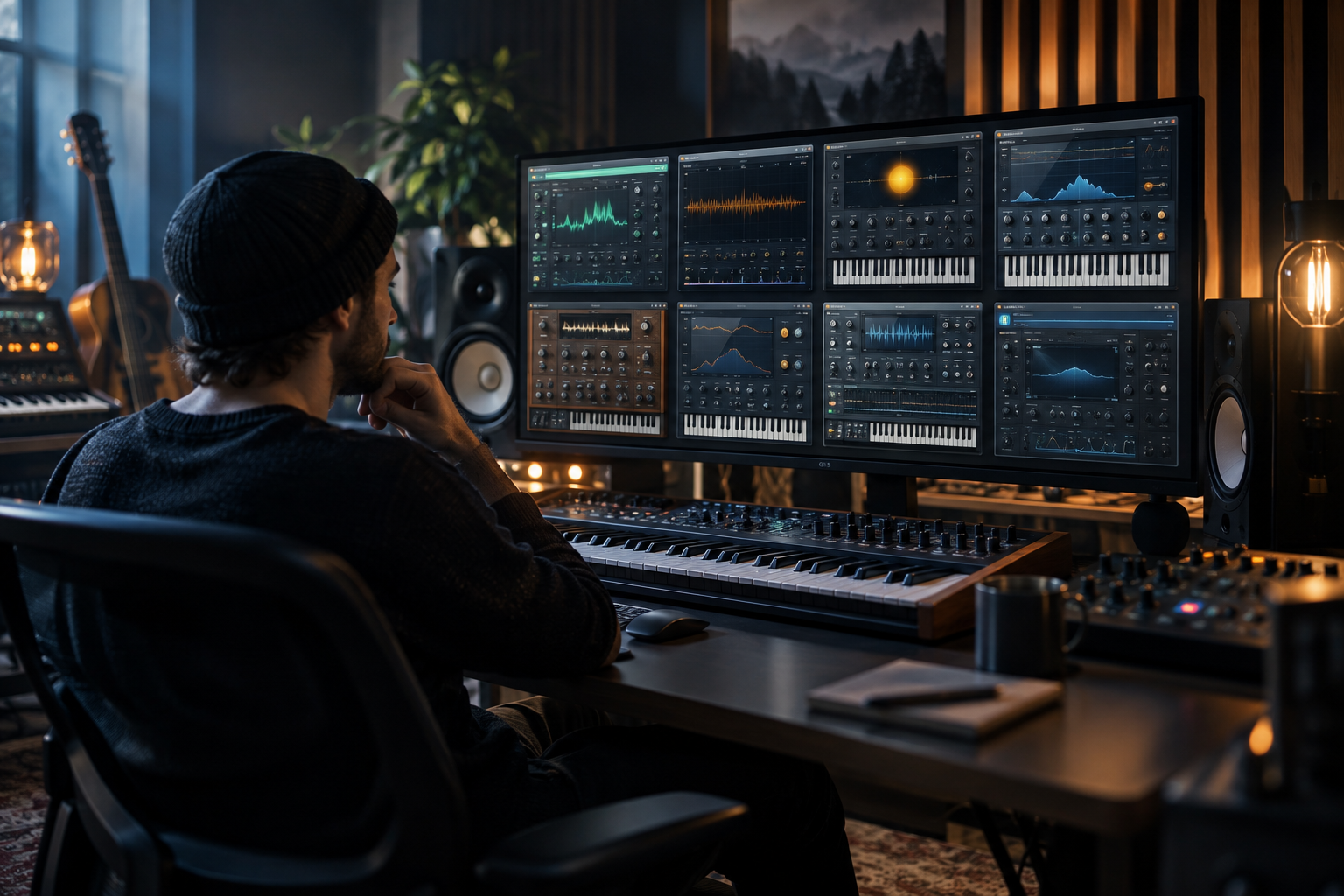
Every session template we build ends up looking the same way: a short list of synths that survive the cut. Not because they’re the newest, or the most hyped, but because they can get us from an empty project to a working idea faster than anything else. The eight below are what actually stay installed and pinned. Some are free, some aren’t, and a couple of them will probably surprise you.
These aren’t ranked. They’re just the ones that keep earning their place after a few hundred sessions.
1. Xfer Serum
Serum has been in our template since before it was fashionable to admit you used it for everything. What keeps it there isn’t the wavetable engine (which is great) or the drag-and-drop modulation (which is genuinely the best in class). It’s the FX and filter section. There’s a deep filter section and a multi-unit effect rack onboard, and being able to build a sound that’s already 80% finished without opening a single insert plugin changes how fast you work.
It doesn’t sound analog. Ignore anyone who tells you it does. But with a bit of work, filter drive, a touch of the noise oscillator, some sub weight, you can get it into analog territory when you need to. The part that actually counts: four sound sources (two wavetables, a configurable noise engine, and a gritty low-end oscillator), 400+ factory patches, and a modulation matrix with four macros, three envelopes and four LFOs. That’s a full sound design environment, not just an oscillator rack.
Splice‘s rent-to-own option means you’re not dropping the full price in one hit, which is worth mentioning because we know plenty of people who’ve put off buying it for exactly that reason.
2. Vital
Vital gets its own paragraph because if you don’t already have it, you’re leaving free money on the table. You get wavetable synthesis alongside sample playback, two filters, drag-and-drop modulation routing, onboard FX, and real-time visual feedback on every parameter. In most practical scenarios it does what Serum does, and it costs nothing.
The catch is real: you don’t get the same depth of wavetables and presets as the paid version. That’s the tradeoff, and it’s worth knowing before you download it and wonder why your patch library feels thin. But the synthesis engine itself is not a cut-down version of anything. It’s a full instrument.
We’ve used Vital as the teaching synth in our own material for a reason, it’s the fastest way to show someone how wavetable synthesis actually works, because every parameter is visible and every modulation is one drag away. Make this the one plugin from the whole list that actually ends up in your rack.
3. Surge XT
Where Vital is a specialist, Surge XT is the Swiss Army knife. Wavetable, subtractive, FM and additive synthesis in one open-source package, with over 2,000 factory presets. Warm analog-style pads, aggressive FM basses, experimental textures, it covers all of it.
The reason it lives in our template is the preset count and the honest breadth of the thing. When you need a starting point fast and you’re not sure what kind of sound you want yet, having 2,000 options in one window beats opening three different synths and auditioning each. Regular updates from a dedicated dev team keep it current, which matters more than people give it credit for, a lot of free synths die slowly after release.
4. u-he Diva
Diva is the one we reach for when a patch has to carry that made on hardware weight, and no stack of plugins gets you there by pretending. It’s not fast to program, it’s not cheap on CPU, and it’s not the plugin you open when you’re sketching. It’s the plugin you open when you’ve committed to a direction and you need the pad or the bass to actually sound like an instrument.
The analog character here is the whole point. Serum can be coaxed into analog territory with effort. Diva starts there and stays there. Different tools for different jobs.
5. u-he Podolski
Podolski is a stripped-back, one-oscillator virtual analog synth by u-he. That’s it. The pitch, in one line.
And that’s exactly why it stays in the template. Sometimes you don’t need three oscillators and a 50-slot modulation matrix. Sometimes you need one oscillator, a filter, and an envelope that just sounds good, so you can stop scrolling and start writing. Podolski puts sound quality ahead of feature count, and the result is an instrument that gets out of the way. We use it for basslines and plucks constantly, specifically because it doesn’t tempt us into sound design rabbit holes.
If you’ve got a session starting and no idea what to reach for, Podolski is a good default.
6. Dexed
Dexed is a faithful emulation of the Yamaha DX7, one of the best-selling synths in history, and it loads original DX7 sysex patches. That last part is why it’s here.
FM synthesis has a reputation for being hard to learn, and honestly, that reputation is earned. Programming FM from scratch is a different mental model from subtractive synthesis, and it takes time. But Dexed sidesteps the learning curve entirely for most day-to-day work, because the patch library that’s grown up around the DX7 over the last forty years is enormous. Electric pianos, bells, metallic basses, glassy pads, you name it, there’s a sysex file for it.
So you get the sound of a legendary instrument with instant access to decades of presets, and then you can go learn FM properly on your own time if you want.
7. KV331 SynthMaster
SynthMaster holds its ground by being the synth we still don’t fully understand after years of use, in a good way. It covers a huge amount of synthesis ground, and every time we think we’ve mapped its range, a session comes along that needs something we’ve never reached for before and SynthMaster has a path to it.
That’s a slightly awkward thing to put in a list like this, because it’s not a feature you can point at. But in a template, the value of a synth that keeps surprising you long after you’ve bought it is enormous. The synths that get retired from our template tend to be the ones we understand completely within a week.
8. TAL-U-No-LX
TAL’s Juno emulation is the last one, and it’s here for the opposite reason to SynthMaster. Everything about it is immediately comprehensible. You open it, you understand it, you program the sound you hear in your head, you move on. There’s no discovery process, no hidden depth, no manual.
That’s not a criticism. The Juno architecture is one of the most musical ever designed, and TAL’s emulation of it is one of the better software versions out there. A lot of the best parts on our records start as a TAL-U-No-LX patch that we then process the hell out of, and that’s fine. The tool doesn’t need to be impressive. It needs to be fast and sound right.
What ties them together
Look at the list and a pattern emerges. We’ve got two synths that are pure depth (Serum, SynthMaster), two that are pure breadth (Surge XT, Dexed’s sysex library), two that are deliberately shallow and fast (Podolski, TAL-U-No-LX), one that’s all about character (Diva), and one that’s both fast and deep (Vital).
That balance is the whole point. A template full of deep synths sounds efficient but stalls constantly, because every new sound starts with a blank patch and fifteen minutes of sound design. A template full of shallow synths gets ideas down fast but hits a ceiling as soon as a track needs something you can’t build with one oscillator.
The other thing to keep in mind: five of these are free or effectively free. Vital, Surge XT, Dexed, Podolski, and there’s a real argument for treating OB-Xf the same way, the Surge Team forked the OB-Xd codebase after discoDSP started charging for it, and OB-Xf is now an open-source continuation of the same Oberheim OB-X emulation. It’s in beta, so download it at your own risk, but if you want warm 80s analog sounds without the price tag, it’s the one to watch. It nearly made the list.
Building your own template
The temptation is to hoard. At some point a new synth drops and it’s easy to just add it to the folder and move on. That’s how you end up with thirty synths installed and three you actually know.
What we do instead is pick a small set and commit. Two deep synths, two broad synths, two fast synths, one character synth, and a free tool that covers the gaps. When something new arrives, it has to displace something already in the template, and it has to do it by being faster or sounding better in an actual session, not by having a bigger feature list.
The eight above have survived that test repeatedly. Most of them probably already have a place in your own list, whether you’ve thought about it that way or not.