Xfer Serum Review: Does the Studio Standard Still Earn Its Slot in 2026?
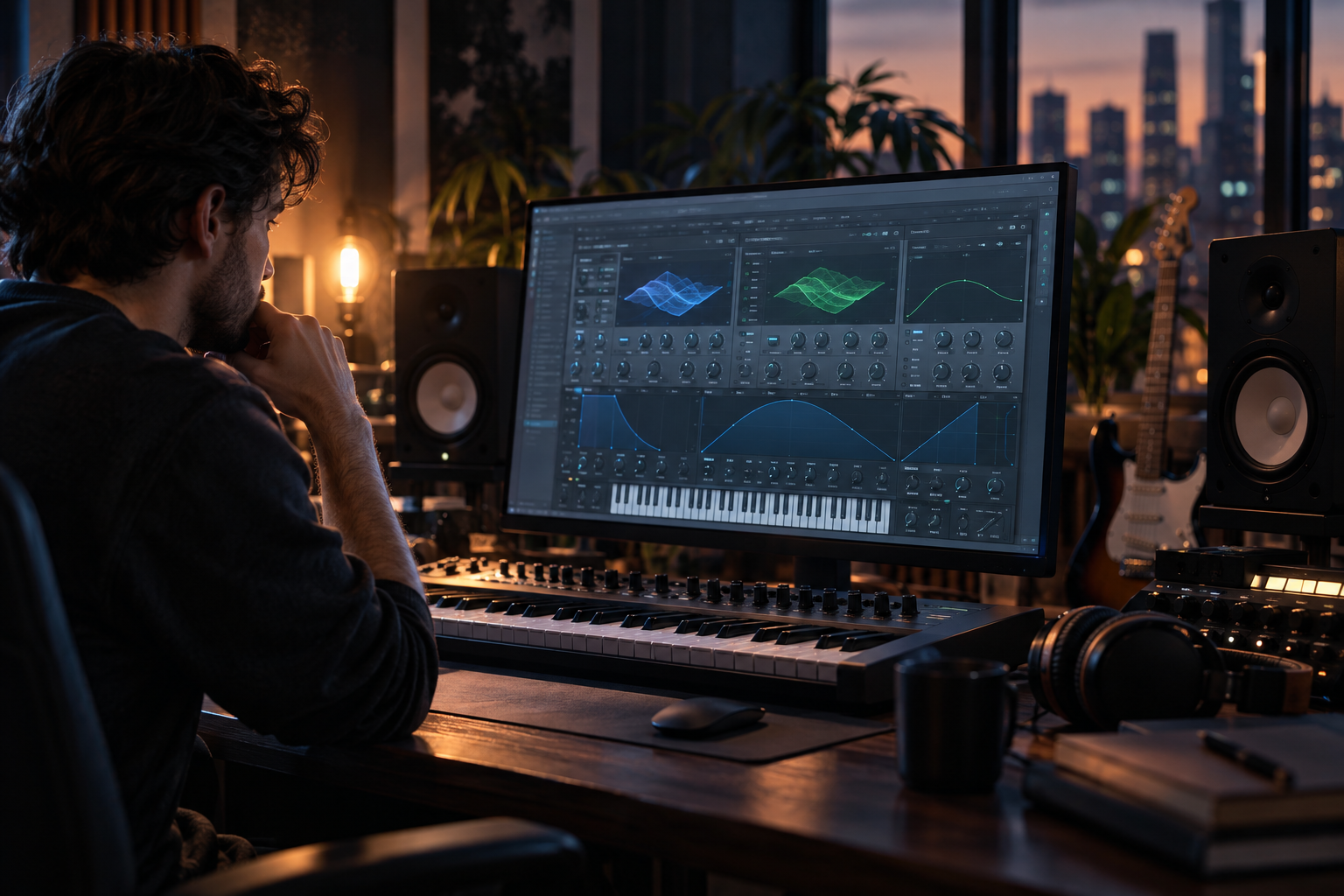
Serum has been sitting in my default template since 2014. It’s the synth I reach for when I need a wavetable bass in five minutes, when a client wants “that modern electronic sound,” when I need to make something weird out of a vocal sample before the session ends. So the real question in 2026 isn’t whether Serum sounds good – it’s whether it still makes sense when Vital is free, Pigments is cheaper, and the wavetable synth market has more competition than ever. Let me walk through where Serum still holds its ground and where it genuinely shows its age.
What You’re Actually Working With
Serum gives you wavetable sources, noise, and a gritty sub to shape your low end. That architecture hasn’t changed and probably won’t. The wavetable engine is still the heart of it – thousands of factory wavetables, the ability to load your own, and the wave morph that made the whole “moving wavetable” thing a genre staple.
The modulation system is where Serum separates itself from most of the competition. Four macro controls, three envelopes, four LFO modules, and a mod matrix that you can drag-and-drop into. You don’t have to route everything through the matrix manually – you grab an LFO, drag it onto a parameter, and it’s assigned. That single workflow decision is why so many producers default to Serum when they’re in a hurry. I’ve watched people who barely know synthesis get a moving pad out of Serum in ten minutes because the assign-to-anything model doesn’t punish you for not knowing what you’re doing yet.
Over 400 factory patches ship with it. I’ll be honest – I skip most of them. But the ones I do use are still in my sessions years later, and they’re a reasonable starting point if you’re learning the interface.
The Filters and FX Are the Real Argument
Here’s where I think Serum still justifies its position. You get a deep filter section and a flexible effect rack built into the plugin. That’s not marketing padding – the filter section alone covers standard LP/HP/BP alongside a pile of character filters that do things like comb, formant, and various flavors of distortion. You can modulate the filter type itself, which opens up sound design moves that are genuinely annoying to recreate elsewhere.
The FX rack – chorus, delay, reverb, distortion, phaser, flanger, compressor, and a few others – is decent, not spectacular. The built-in reverb won’t replace a dedicated unit. But having ten effects accessible inside your synth, modulatable alongside everything else, means you can finish a sound in Serum and bounce it without stacking a chain behind it. For producers working quickly, that matters more than reverb quality.
One honest caveat: Serum doesn’t sound analog. It’s not trying to. If you want that Diva-style warmth, you’ll need to add saturation and filtering tricks to get into that territory. The tradeoff is that Serum sounds clean and precise, which is often exactly what you want – and it’s why it sits so well in dense mixes. You’re not fighting its character.
Workflow Reality Check
The interface philosophy is the thing I appreciate most after a decade. Everything is on one screen. No tabs, no hidden sub-menus you have to hunt for. Drag any modulator onto any parameter. Right-click for the mod matrix. Save your own wavetables and presets without ceremony.
The cost of that simplicity is that Serum isn’t a deep modular environment. If you want to build a complex multi-layered patch with custom routing between oscillators and effects, you’ll hit the ceiling. This is a subtractive/wavetable synth with a strong modulation system – not a Phase Plant or Falcon-style sandbox. Know that going in.
CPU usage is reasonable. Not the lightest synth on the market, but I’ve never had Serum choke a session on its own, even with multiple instances running modulated wavetables. The built-in effects rack adds load but nothing dramatic.
Pricing and the Rent-to-Own Angle
Serum isn’t cheap. But Xfer has an option that shifts the equation for plenty of producers: rent-to-own via Splice at 0% interest. Each installment chips away at the price until the license is yours, and – this is the bit I genuinely rate – you can pause the plan whenever cash is tight and resume from the same spot. No interest, no penalty, just a pause. For producers on a tight budget who want a legit license rather than a crack, that’s a real pathway in.
Keep this in mind: Xfer isn’t only Serum. The same team makes OTT, the multiband compressor that uses simultaneous upward and downward compression across three bands to produce that aggressive hyper-real electronic sound. It’s so ubiquitous that FabFilter effectively aped the behavior in Pro-C 3. That tells you something about how much influence this one developer has had on the sound of modern electronic music. LFO Tool is another Xfer staple for volume shaping and ducking.
How It Stacks Up in 2026
Vital is free and covers a lot of the same wavetable territory with a visual spectral warping approach and equally capable modulation. If your primary concern is cost, Vital is the obvious answer, and it’s a genuinely excellent synth.
Pigments from Arturia offers a different flavor – more color, more experimental architecture – and it’s often priced attractively. Diva, Massive X, Sylenth1, Omnisphere all occupy different niches. Serum’s position is “wavetable workhorse with the fastest modulation workflow.” It’s a solid default, not a specialist.
Where Serum still wins: preset ecosystem. The third-party preset market for Serum is enormous – thousands of packs from sound designers who built entire careers on it. If you want to sound like a specific genre today, Serum has a pack for it. That network effect is real and hard to replicate.
Where It Falls Short
- No analog emulation. Don’t buy it expecting tape warmth or oscillator drift out of the box.
- Limited architecture depth. Serious modular sound designers will outgrow it.
- Built-in reverb and delay are functional, not inspiring. Budget for a proper reverb.
- Full price is a commitment compared to free alternatives that cover similar ground.
My Verdict for 2026
Serum still holds its ground, but not for everyone. If you’re a working producer who needs fast, reliable wavetable sounds with best-in-class modulation workflow and access to the largest preset market in the industry, it remains one of the smartest purchases you can make. The rent-to-own path through Splice with payment freezing removes most of the financial friction.
If you’re purely a sound designer chasing experimental architecture, or you’re strictly budget-bound, look at Vital or Pigments first. Serum isn’t the only answer anymore, and anyone claiming it’s untouchable in 2026 isn’t paying attention to what’s shipped since.
But when I open a session and need a bassline in five minutes that will sit in the mix – Serum still gets the click. Ten years in, that consistency is the whole review.